
Service · Hillsdale, MI
Indoor Air Quality in Hillsdale, MI
Combustion safety comes first here — filtration is the third question
In Hillsdale, MI and across the county: combustion safety first, then ventilation, then filtration — in that order, because that is the order the risk runs in.
Wood is the primary heat for 1,619 households in Hillsdale County, Michigan — four times the state rate — on top of a third of the county burning propane. Very few places in Michigan have this much combustion happening indoors.
Request service
- 1,619 households heat primarily with wood — 9.1% of the county against 2.3% statewide US Census ACS B25040
- 36.2% burn propane, and another 2.5% fuel oil US Census ACS B25040
- 26.7% of the housing predates 1940 — leaky envelopes, little deliberate ventilation US Census ACS B25034
Combustion Safety Comes First
This county burns things indoors more than almost anywhere else in Michigan. From ACS table B25040, of 17,858 occupied housing units: 36.2 percent heat with bottled, tank or LP gas, 9.1 percent with wood — that is 1,619 households, against a state figure of 2.3 percent — and 2.5 percent with fuel oil or kerosene. Natural gas accounts for another 44.1 percent.
So before any conversation about filters or humidifiers, the questions that matter are about combustion: are the appliances venting properly, are there working carbon monoxide alarms, and is anything unvented being used for heat.
If a CO alarm sounds
Leave the building, take everyone with you, and call 911 from outside. Do not go back in to investigate. The same applies to a gas smell — though the Propane Education and Research Council notes that smell is not a reliable warning on its own, because propane's odorant can be lost through contact with soil, water or rust.
And never run a stove, an oven or an unvented heater for warmth when the heating fails. That is how a heating problem becomes a carbon monoxide one. See emergency heating.
Old Houses Are Draughty and Stale at the Same Time
An old house can be draughty and stale at the same time, which sounds contradictory until you separate air leakage from ventilation. Leakage is uncontrolled: it happens when the wind blows and stops when it does not. Ventilation is deliberate and continuous. Pre-war construction has a great deal of the first and almost none of the second.
Which produces a house that is draughty when the wind blows and stale when it does not — because the air exchange is uncontrolled rather than absent. Retrofits often make this worse before better, sealing the obvious leaks without adding any designed ventilation to replace them.
The honest version of this conversation starts with the building, not with a product. And a good part of it is ductwork rather than air handling: see ductwork.
Dust Is Usually a Duct Problem
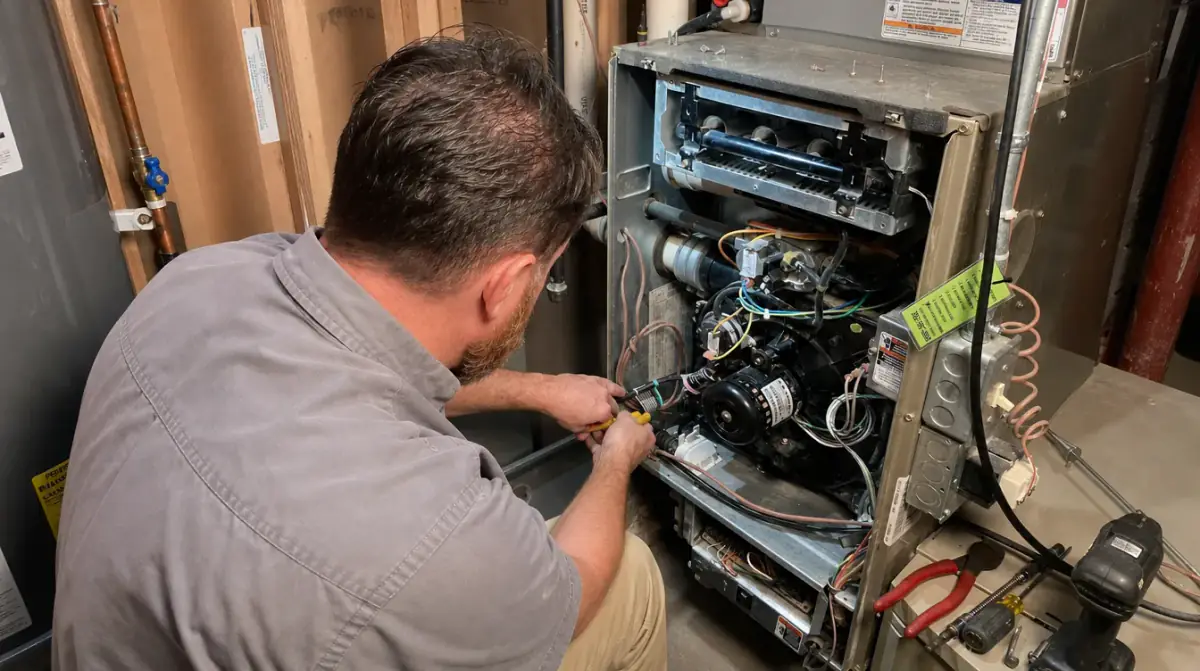
The most common indoor air complaint in this housing stock is dust that comes straight back after cleaning. The reflex answer is a better filter. The more frequent cause is unsealed returns pulling air out of a crawl space, an unheated basement or a knee wall and delivering it to the rooms.
A higher-grade filter treats that symptom while the duct system keeps supplying the cause — and a filter too restrictive for the blower creates airflow problems of its own. Rule out the ducts first.
We publish no equipment recommendations or prices on this page. Our research file has sourced material on combustion safety, housing age and heating fuel, and nothing sourced on filtration, humidification or air cleaner performance — so we are not going to fill the gap with manufacturer claims. What is above is what we can stand behind.
Indoor air quality by Town
We cover indoor air quality in every town and township in the county.
- Indoor air quality in Hillsdale, MI 49242
- Indoor air quality in Jonesville, MI 49250
- Indoor air quality in Litchfield, MI 49252
- Indoor air quality in Reading, MI 49274
- Indoor air quality in Pittsford, MI 49271
- Indoor air quality in Waldron, MI 49288
- Indoor air quality in Camden, MI 49232
- Indoor air quality in North Adams, MI 49262
- Indoor air quality in Allen, MI 49227
- Indoor air quality in Jerome, MI 49249
- Indoor air quality in Osseo, MI 49266
Indoor Air Quality FAQ
Why does indoor air quality matter more in Hillsdale County?
Because of how the county heats itself. Wood is the primary heating fuel for 1,619 households here — 9.1 percent of occupied homes, against 2.3 percent for Michigan as a whole, per US Census ACS table B25040. Another 36.2 percent burn propane and 2.5 percent fuel oil. That is a very high share of homes with combustion happening inside them, in a housing stock where 26.7 percent of buildings predate 1940. Combustion safety is not a niche concern here, it is the main event.
Do I need a carbon monoxide alarm if I heat with wood or propane?
Any home with combustion appliances should have working CO alarms, and in this county that describes the large majority of them. If an alarm sounds, leave the building, take everyone with you, and call 911 from outside — do not go back in to investigate. That is also the correct response to a gas smell, though the Propane Education and Research Council warns that smell is not a reliable indicator on its own: propane’s odorant can be lost through contact with soil, water or rust.
Is my old house too draughty or too tight?
Often both, in different places. Pre-1940 houses — better than a quarter of this county’s stock — leak at the envelope while having very little deliberate ventilation, and retrofits frequently tighten the obvious leaks without adding any controlled air exchange. The result is a house that is still draughty in a wind and still stale in still weather. That is a diagnosis question rather than a product question, and any answer that starts with a piece of equipment before it starts with the building is answering backwards.
Will a better filter fix my dust problem?
Sometimes, but in this housing stock the more common cause is ductwork rather than filtration. Dust that returns immediately after cleaning often means unsealed returns pulling air from a crawl space or an unheated basement — in which case a higher-grade filter treats the symptom while the duct system keeps supplying the cause. Worth ruling that out first. And note that a filter too restrictive for the blower creates its own problems.
Ask About Indoor Air Quality
Tell us what heats the house, whether there is a wood stove in use, and what you are noticing — dust, smells, humidity, or a CO alarm that has gone off.
There is no phone number published on this site yet, so requests come in through this form — we reply by email or call you back on the number you give. That is also why the phone field is required rather than optional.
Where these numbers come from
Heating fuel shares, including the 1,619 wood-heated households: US Census American Community Survey table B25040. Housing age: ACS B25034. Propane safety, including the odorant warning: Propane Education & Research Council. No filtration, humidification or air cleaner performance figures are published on this page because we have no sourced material for them; this page deliberately covers only what our research supports.