
Service · Hillsdale, MI
Air Conditioning Repair in Hillsdale, MI
Cold and clammy is a sizing problem, not a broken compressor
In Hillsdale, MI and across the county: cooling faults, the humidity problems that are really sizing problems, and the ductwork that gets blamed on the compressor.
Hillsdale County, Michigan is a heating county with a short cooling season, which means air conditioning here is often an add-on to a system designed around winter — and that is where most of the faults come from.
Request service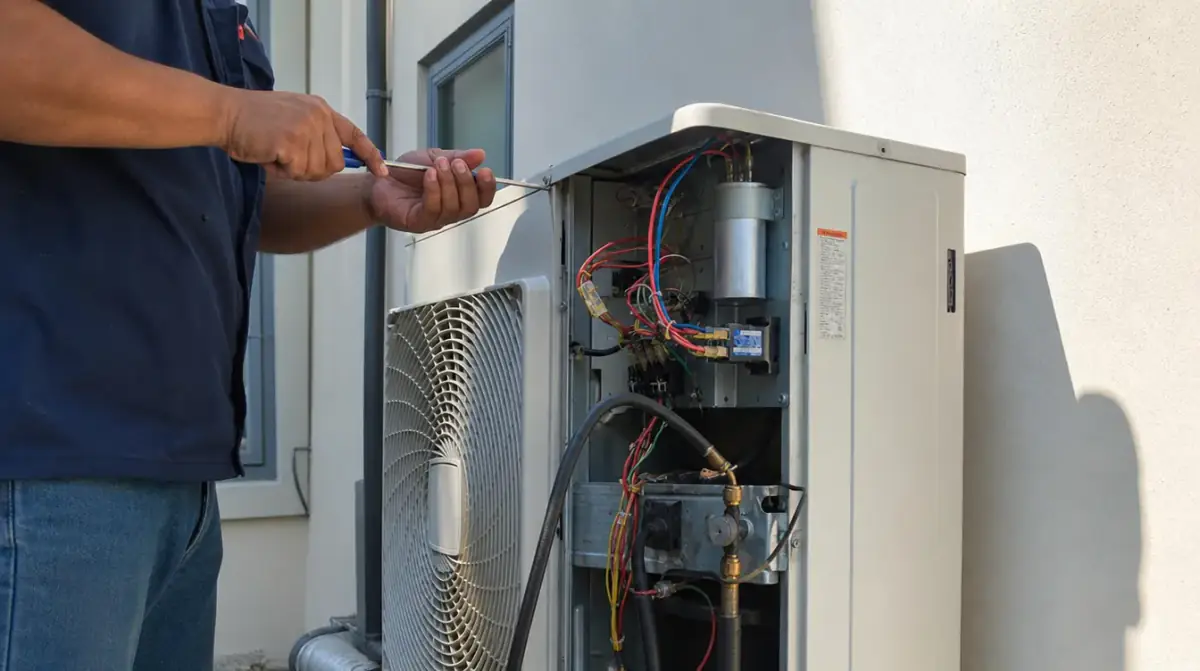
- $65 Consumers AC tune-up rebate — claimable only between 1 April and 30 September Consumers Energy 2026
- 26.7% of county housing predates 1940, so the ducts are often the real fault US Census ACS B25034
- 5A IECC climate zone — a short cooling season on equipment designed around winter DOE Building America
What Gets Checked on an AC Repair Call
Most air conditioning faults come down to one of four things: airflow, refrigerant charge, electrical components, or the condensate drain. A diagnosis works through them in that order, because the cheap causes sit at the top and the expensive ones at the bottom.
Before you call, check these
- The filter. A blocked filter starves the coil, ices it up and presents as "no cold air".
- The thermostat — set to cool, batteries alive, calling.
- Both breakers. Air conditioning usually has its own circuit as well as the furnace circuit.
- The outdoor unit — clear of leaves, grass clippings and anything stacked against it.
What the common faults look like
- Runs but does not cool — low charge, a dirty condenser coil, or a failed compressor.
- Ices up — nearly always airflow: filter, blower or ductwork.
- Will not start, hums, or trips the breaker — usually a capacitor or contactor.
- Water where it should not be — a blocked condensate drain.
- Cools downstairs, not upstairs — that is a duct problem, not an equipment one. See ductwork.
A refrigerant top-up on its own is not a repair. Refrigerant is not consumed — if the charge is low, there is a leak, and the leak is the fault worth finding.
What Actually Fails
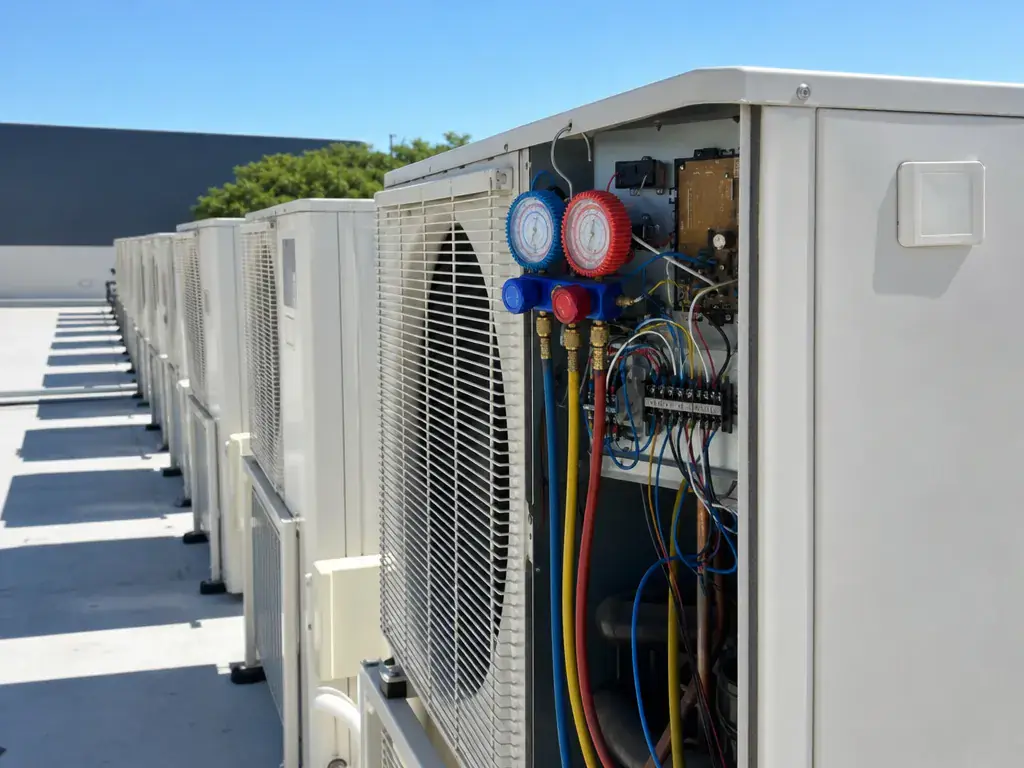
The ordinary catalogue — capacitors, contactors, condenser fan motors, refrigerant leaks, a blocked or frozen coil, a condensate drain that has backed up, thermostat and control faults. None of that is specific to this county.
What is specific is the context. Hillsdale County sits in IECC climate zone 5A, "Cold", per DOE Building America, with 6,469.8 heating degree days a year on the NOAA 1991–2020 normals. This is a heating market, and cooling equipment here is frequently an addition to a system that was designed, sized and installed around winter. Two consequences follow, and they cover most of the calls: the air handler and ducts were sized for heating rather than cooling, and the system runs few enough hours that faults accumulate quietly between seasons.
Cold but Humid Is Usually Oversizing
The most common complaint that is not a repair. An oversized air conditioner brings the air temperature down to the thermostat setting quickly and then stops. Because it never runs a long cycle, it never pulls much moisture out of the air, and the house ends up cold and clammy rather than comfortable.
That is the same short-cycling failure Building America guidance identifies for ductless systems — where it notes correct sizing per zone is imperative or you get short-cycling and poor humidity control. The answer is a load calculation, ACCA Manual J, and equipment selected against it with Manual S. Replacing a component on an oversized system fixes nothing.
When the Air Conditioner Is Not the Problem
A good share of cooling complaints are not equipment faults. If the downstairs is comfortable and the upstairs never gets there, the air conditioner is usually doing its job and the duct system is failing to carry the result — undersized returns, long runs, or a trunk that was pinched where it had to pass through something. That pattern is common in houses whose ducts were retrofitted decades after they were built, which describes most of the pre-war stock in this county.
Cooling exposes those weaknesses harder than heating does, because cold air is denser and less willing to be pushed a long way. A room that is merely cool in winter is often plainly hot in July. If one floor never keeps up while the rest of the house is fine, look at ductwork before replacing equipment — and if the house has no ducts at all, which is common in the hydronic stock here, see ductless mini-splits.
AC Rebates in Hillsdale County, MI
Consumers Energy's 2026 residential measures, for its electric customers: $65 for an AC tune-up — claimable only between 1 April and 30 September — $150 or $300 toward central air conditioning, $350 for a ductless mini-split, $300 for an air-source heat pump at 15.2+ SEER2, $200 or $300 for ground-source, and $50 or $100 for a smart thermostat.
Whether you can claim any of it depends on your electric supplier
Inside the City of Hillsdale, electricity comes from the Hillsdale Board of Public Utilities — a municipal utility with 6,131 customers — so those homes are not Consumers electric customers and their efficiency programme runs through Efficiency Smart instead. Outside the city limits it is Consumers, and the measures above apply. See heating and cooling in Hillsdale, MI.
We publish no AC repair price because we have no sourced figure for one. Full rebate table on what things cost. Nothing federal applies — 25C covers only property placed in service before 31 December 2025, per the IRS.
AC repair by Town
We cover ac repair in every town and township in the county.
- AC repair in Hillsdale, MI 49242
- AC repair in Jonesville, MI 49250
- AC repair in Litchfield, MI 49252
- AC repair in Reading, MI 49274
- AC repair in Pittsford, MI 49271
- AC repair in Waldron, MI 49288
- AC repair in Camden, MI 49232
- AC repair in North Adams, MI 49262
- AC repair in Allen, MI 49227
- AC repair in Jerome, MI 49249
- AC repair in Osseo, MI 49266
AC Repair FAQ
How much does AC repair cost in Hillsdale County, MI?
We do not publish an air conditioning repair price, because we have no sourced local or statewide figure for one and a precise-looking invented number is worse than none. What we can tell you is where the money genuinely moves: Consumers Energy pays its electric customers $65 for an AC tune-up, but only between 1 April and 30 September, and $150 or $300 toward a new central air conditioner. Whether you can claim either depends on whether Consumers is actually your electric supplier, which inside the City of Hillsdale it is not.
My AC runs but the house stays humid. Is that a repair?
Often it is a sizing problem rather than a fault. An oversized system cools the air to the thermostat setting quickly and shuts off, so it never runs long enough to pull moisture out — you get a cold, clammy house. That is the same short-cycling failure Building America guidance warns about for ductless systems, and the fix is not a repair but correct sizing by ACCA Manual J. Worth establishing before anyone replaces a component.
Why is my upstairs always hotter than the rest of the house?
In this county the usual answer is ductwork rather than the air conditioner. 26.7 percent of Hillsdale County housing was built in 1939 or earlier, against 14.5 percent statewide, and ducts in that stock were retrofitted into buildings never designed for them: long runs, undersized returns, trunks pinched through joist bays. A system that cannot get air back out of a room will not cool it however much capacity is sitting in the basement.
Do you repair air conditioning on houses that heat with a boiler?
Yes, and it is a common situation here because so much of the housing stock is hydronic. Radiators cannot carry cold air, so those houses either have a separate duct system, window units, or a ductless system. If yours has no ducts at all, the repair conversation and the replacement conversation are quite different — a ductless head is serviced differently from a central system, with professional blower-wheel cleaning every one to three years per Building America guidance.
Is it worth repairing an old air conditioner or replacing it?
The three questions worth asking are the same as for heating: whether the duct system can carry what a new unit would move, whether the existing unit was ever sized for the house as it is now, and whether replacement unlocks money repair does not. On that last point Consumers Energy pays its electric customers $150 or $300 toward a new central air conditioner, and $350 toward a ductless mini-split — which is a real difference, but only for Consumers electric customers.
Request AC Repair
Tell us what it is doing — not cooling at all, running constantly, cooling but leaving the house humid, or one floor never keeping up. Those point at four different causes.
There is no phone number published on this site yet, so requests come in through this form — we reply by email or call you back on the number you give. That is also why the phone field is required rather than optional.
Where these numbers come from
Housing age: US Census American Community Survey table B25034. Climate zone and degree days: DOE Building America and NOAA 1991–2020 Climate Normals, Jackson Reynolds Field (KJXN). Sizing standards and the short-cycling/humidity guidance: ACCA Manual J and Manual S, and DOE/PNNL Building America. Rebate amounts, conditions and the 1 April–30 September tune-up window: Consumers Energy 2026 programme documentation. Utility territories and the Hillsdale BPU customer count: Michigan Public Service Commission. Federal credits: IRS. No AC repair price is published because we have no sourced figure for one.